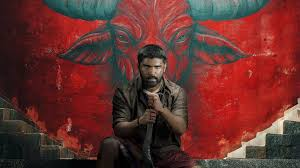

There is no easy way to say this. In Mali Selvaraj’s Bison Kaalamaadan, young Dhruv Vikram proves himself a better actor than his father Vikram, which is really saying a lot.
I watched the young actor disappear into his character in the way Kamal Haasan did in his earlier films (before he became a parody of himself) or the way Daniel Day-Lewis did in My Left Foot, and Matthew McConaughey did in Dallas Buyers Club.
Full marks to the producers for recognising the spark in the young actor after his botched up debut in Aditya Varma. As a Kabaddi player struggling with caste and financial hurdles, Dhruv proves himself the finest actor of the new generation, far ahead of his hyped competitors from Hindi cinema. Providentially, Dhruv gets abundant support from Mari Selvraj’s screenplay, which is taut and rugged, and yet soft and supple when the need arises.
Most of all, the tone of narration is non-judgmental, even in the most brutal of circumstances. Interestingly, the rigours of the game of Kabbaddi resonate with the tone of narration and the temperament of the protagonist.
Dhruv Vikram plays Kittan Velusamy as a creature of the dark who won’t allow himself to be swallowed by the darkness that has been bequeathed to him. He is a ‘backward’ who will move forward, come what may.
The visuals during the game and outside the field suggest a coalition between destiny and self-actualisation.
Unlike other celluloid sports legends like Rocky Balboa and Jake LaMotta (Raging Bull), Kittan Velusamy’s commonness is his greatest strength. He won’t be struck down by negative forces which assail him on every raging step that he takes.
Though laden with a looming ferociousness, the storytelling is never over-burdened with plotting prevarication. There is a magnetic clarity of intent in the storytelling.
The protagonist may be an underdog. But he is never caught in a dim light.
Dhruv gets a bevvy of supportive actors to make his onscreen journey a resounding success. Pasupathy as Kittan’s father and Azhagam Perumal as his coach are all things visceral. And yes, the women are not sidelined even though the sport and its ramifications are rightly treated as masculine entities. There is a palpable bonding between Dhruv and the two women in his life, played by Anupama Parameswaran and Rajisha Vijayan.
To define Bison Kaalamaadan as a sports film would be absurdly literal. This is a work of multi-faceted splendour, a mirror to a society that still favours the strong and weakens the weak.