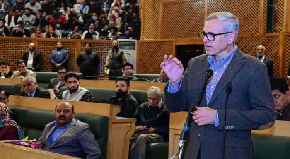

Jammu and Kashmir Chief Minister Omar Abdullah cautioned the Election Commission of India (ECI) against rushing the implementation of the Simultaneous Implementation of Reforms (SIR) across the country, warning that any haste could lead to accusations of bias towards a particular political party.
Addressing the Assembly in Srinagar, Abdullah said doubts have already emerged among people regarding the SIR exercise conducted in Bihar.
“We have seen skepticism among the public about the SIR in Bihar. We don’t know yet whether it will actually benefit those who implemented it. Let the Bihar elections conclude first, and then we will see if SIR proved beneficial or not. The ECI should wait and assess the outcome instead of acting in haste, or it will once again face allegations of working under political pressure,” he said.
Chief Minister Abdullah further recalled that the delimitation process in Jammu and Kashmir was carried out not to empower people but to favor a particular political party.
“The way seats were divided and new ones created clearly benefited one political party. The ECI must avoid repeating the same mistake,” he added.
Chief Minister Abdullah also accused the Bharatiya Janata Party (BJP) of engaging in religion-based politics by excluding Muslims from parliamentary representation. Responding to a BJP legislator during the session, Abdullah said, “We assure that flood relief will be distributed fairly and without discrimination; that is not our politics. But it is the BJP that has deliberately excluded Muslims from the central government. Neither in the Lok Sabha nor the Rajya Sabha does the BJP have a single Muslim MP.”
Reiterating that his party, the National Conference (NC), is the only one in Jammu and Kashmir willing to directly challenge the BJP, Chief Minister Abdullah contrasted his party’s stand with that of the Congress. “Even the Congress did not field its candidates in recent elections. The NC does not operate on secret understandings,” he remarked.
On the issue of Jammu and Kashmir’s statehood, Chief Minister Abdullah expressed growing disappointment over the delay, saying that hopes for its restoration are fading with each passing day. “I have been hopeful about the restoration of statehood from day one. However, as the delay continues, those hopes are fading with each passing day,” he said.
Just a day earlier, on October 26, Chief Minister Abdullah had warned that he would resign as Chief Minister if statehood was not restored within a “finite timeline,” a statement that has stirred political debate across the region.
He also clarified his conversation with MP Mian Altaf, who reportedly made remarks about the Chief Minister’s position. “I spoke to Mian Altaf Sahab yesterday. He told me he hadn’t said what was being reported and only advised me to speak patiently and carefully regarding the CM’s role,” Chief Minister Abdullah said. When asked about a similar remark from MP Aga Ruhullah, he replied, “Why compare Mian Sahib with him? There’s a ‘zameen-aasman’ difference between Aga Ruhullah and Mian Altaf.”
Jammu and Kashmir’s statehood was revoked on August 5, 2019, when the central government removed its special status under Article 370 and reorganized the region into two Union Territories, Jammu and Kashmir, and Ladakh. In December 2023, the Supreme Court upheld the constitutionality of this decision.
While the Centre has maintained that statehood will be restored at an “appropriate time,” Chief Minister Abdullah and other regional leaders have repeatedly demanded a fixed timeline for its return.