
Clutching their rifles like lifelines, new fighters lace up worn-out boots in the steaming streets of Goma. They prepare for another war, as Washington parades a so-called peace treaty to the world. On June 27, in the grand halls of Washington, American officials watched the foreign ministers of Rwanda and Congo sign a document that President Donald Trump hailed as a “wonderful treaty”. He called it proof that his hand could settle even Africa’s bloodiest wars.
But in eastern Congo, the gunfire has not stopped. The militia wars that began in the ashes of the 1994 genocide still burn, and more than 6 million lives have already been lost. To many in Goma, the treaty is nothing more than an American photo-op or a cover for deeper ambitions.
Rebel Voices Against Kinshasa
Corneille Nangaa, once a key election official and now a rebel leader, told reporters inside rebel-held Goma that his coalition, the Alliance Fleuve Congo (AFC), had one goal: march to Kinshasa and overthrow President Félix Tshisekedi.
He described Tshisekedi as illegitimate and corrupt. Liberation, Nangaa said, was the only option, and the state had to be rebuilt from the ashes.
The group M23, which forms the muscle of this coalition, had already swept through Goma and Bukavu in a lightning offensive this year. The Congolese government counted more than 7,000 deaths since January.
M23 claims to defend the region’s Tutsi minority, but Kinshasa accuses it of massacres and Rwanda of fuelling its rise. Neither M23 nor Nangaa’s coalition had been included in Washington’s talks.
Still, Trump bragged in London that the machete wars of Congo were “settled”. He said nearly 10 million people had died, but America had put an end to it.
Experts laughed at his claim.
UN Paints A Darker Picture
As Washington celebrated, UN investigators at the same time revealed horror. Between January and July, their report documented summary executions, disappearances, torture and rape across North and South Kivu.
In one massacre in Rutshuru, Rwandan soldiers-backed M23 fighters hacked hundreds of civilians to death with machetes. It was one of the deadliest attacks since M23’s resurgence.
Volker Türk, the UN human rights chief, told delegates that victims had been beaten, suffocated and starved to death. Rwanda’s involvement, he added, could not be ignored.
Human Rights Watch echoed these findings, describing mass killings near Virunga National Park.
The M23 brushed aside the accusations as lies, with Nangaa insisting that Kinshasa and its allies invented them to raise donor money. He denied Rwanda’s role, though much of the international community pointed at Kigali’s fingerprints all over the violence.
Minerals Over Lives
Trump revealed what Washington really wanted when he told reporters the peace deal would allow America to secure “a lot of the mineral rights from the Congo”.
Congo is the world’s largest source of cobalt and coltan, metals that power US smartphones and electric cars. Rebels and militias fight over these resources, while civilians starve.
Nangaa scoffed at Trump’s words. The minerals, he said, belonged to the Congolese people, not to Tshisekedi or Washington. He warned that any deal signed in the Oval Office without addressing Congo’s real problems, which are corruption, ethnic division and bad governance, was meaningless.
Lives In Ruins
Eight months after the M23 took Goma, its markets buzz again with chickens, spices and chatter. But every conversation carries fear. Traders whisper that things are “kind of OK”, but they do not dare talk about life under rebel guns.
The United Nations counted 7.8 million displaced people across eastern Congo, the highest on record. Hunger stalks the land. The World Food Programme warned that 28 million people now need urgent aid, and 4.75 million children are at risk of severe malnutrition.
But in July, the United States slammed the brakes on the USAID, the agency that fed millions. With $6 billion withdrawn, rape kits for survivors of sexual violence vanished from clinics, and humanitarian groups fell silent for lack of cash. Congo bled while America walked away.
A War That Never Ends
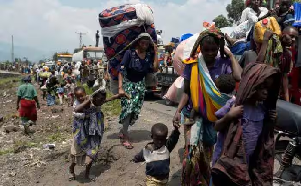
In Masisi, north of Goma, battles rage daily. More than a million have fled. Families wander roads, some forced across the border into Rwanda as “repatriates”, though many were born in Congo and have never seen Rwanda. Camps for the displaced have been torn down, and people sent back to ruins that were once their homes.
Doctors Without Borders treated more than 7,400 survivours of sexual violence between January and April alone. Women lined up for medicine, with their stories hiding in silence.
The Truth On The Ground
As Washington congratulates itself, Congo knows the truth. Rebels fight not for US minerals but for survival, cassava and rice. Villagers cling to scraps of land. Mothers bury children.
One aid worker summed it up: fighting happens every day. For Congo’s people, the war is not in Washington. It is here, in Goma, in Bukavu, in Rutshuru.
And the so-called American peace deal? Just another piece of paper soaked in blood.