
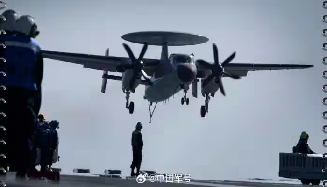

Beijing has taken its naval aviation to a new level. The People’s Liberation Army Navy (PLAN) showcased operations of its first catapult-equipped aircraft carrier, the Fujian, with imagery confirming simultaneous activity of the next-generation J-35 stealth fighters, J-15T single-seat fighters and KJ-600 airborne early warning and control planes.
The footage shows the aircraft preparing for catapult launches, taking off, performing arrested recoveries and flying in formation. It marks an unprecedented leap for Chinese carrier aviation.
The carrier’s deck also hosts the Z-9 helicopter, a license-produced variant of the Eurocopter AS365 Dauphin, performing plane guard roles during launches and recoveries. The presence of the J-15D electronic warfare variant alongside the trio demonstrates the full operational complexity.
Fujian has been at sea trials since May 2024, and official photos in August hinted at fixed-wing operations, though takeoffs and landings had not been confirmed. The release of video showing all three aircraft in active trials represents a significant milestone for the People’s Liberation Army Navy.
The J-15T is a catapult-optimised derivative of the J-15. It is a Chinese adaptation of the Soviet Sukhoi Su-33. Unlike previous STOBAR carriers with ski-jumps, the T-model is designed to launch from electromagnetic catapults and allows higher operational weights and more efficient deployments.
Adapted from the land-based FC-31, the J-35 is China’s first stealth carrier fighter that has been built for catapult launch from the outset. Its debut aboard Fujian confirms China’s ability to deploy stealth and conventional fighter jets simultaneously in Catapult Assisted Take-Off But Arrested Recovery (CATOBAR) operations.
The KJ-600, China’s airborne early warning platform comparable in function to the U.S. Navy’s E-2 Hawkeye, also made its first operational appearances. Three examples were seen on deck, highlighting its role in enhancing command, control and situational awareness at sea.
The Fujian’s electromagnetic catapults represent a technical leap. Testing began in 2023 while the ship was still in construction.
Unlike the U.S. Navy, which mastered steam-powered catapults over decades, Beijing has successfully implemented Electromagnetic Aircraft Launch System (EMALS), enabling precise launches for aircraft ranging from the heavy KJ-600 to stealthy J-35 fighters. The J-35 becomes the first stealth jet globally to launch from an EMALS-equipped carrier.Observers say that the Fujian is likely to operate advanced uncrewed platforms in the future. EMALS’ flexibility will support drones and unmanned combat air vehicles, expanding the People’s Liberation Army Navy’s operational envelope well beyond traditional fixed-wing aviation.
The Fujian project illustrates China’s broader naval modernisation. Apart from advanced surface combatants and submarines, the Navy is reportedly developing a second CATOBAR carrier, the nuclear-powered Type 004.
The expanding carrier fleet aligns with Beijing’s strategic ambitions, from potential intervention near Taiwan to blue-water operations across the Pacific.
Apart from being a carrier, Fujian, for China, is a symbol of technological achievement and naval power projection. With operational deployment expected by year-end, the People’s Liberation Army Navy’s new carrier and its advanced air wing are poised to redefine regional maritime dynamics.