

Adya Madhavan
Though the precarious ceasefire between Israel and Iran held up, the broader conflict between the two has opened a conversation about nuclear proliferation in West Asia, one that could have far-reaching implications for the region. For India, it means new questions in its security environment and an opportunity to leverage its ties with both countries to shift the tide away from crises and towards a dialogue.
The large-scale air campaign against Iranian facilities that Israel launched in mid-June, aided by US strikes, was justified as an attempt to put a stop to the development of Iran’s nuclear programme. Israel eliminated Iranian nuclear scientists and research facilities despite Tehran’s ardent insistence that it was not looking to develop nuclear infrastructure for military purposes, as well as reports by the International Atomic Energy Agency (IAEA) that backed these claims.
The Incentive For Iran
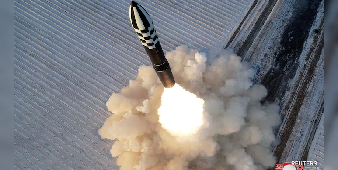
One byproduct of these strikes that could come back and bite both Israel and the US is the perceived increase in incentive for Iran to build a bomb. So far, despite reports of covert attempts to develop nuclear infrastructure, Iran has not demonstrated either purpose or intent to that effect. For Iran’s hardline factions, the conflict with Israel can now serve as the single most powerful argument for developing a nuclear weapon. Iran has watched states like North Korea remain untouchable behind their nuclear arsenals and volatile governments, while nations that gave up their nuclear programmes, like Libya, faced tumultuous foreign-backed regime changes. Israel itself – widely acknowledged as an undeclared nuclear-armed state – operates with relative impunity.
While many Iranian moderates have argued time and again that diplomacy and de-escalation are the way forward, the clashes with Israel can now be used as an internal argument that diplomacy and conventional deterrence don’t work. Hardliners can use this to push for developing nuclear capabilities as the only way to ensure that Iran remains sovereign. The tragic irony is that the very measures taken to prevent Iran from going nuclear may end up forcing that very outcome.
A Knife-Edged Threshold
While the incentive for Iran for nuclear proliferation is high, an inherent contradiction exists, driven by Israel’s clear red line when it comes to preventing what it perceives to be ‘existential threats’. Israel has been unequivocal about the fact that it will go to great lengths to prevent Iran from acquiring nuclear capabilities, and has shown its willingness to put its military might where its mouth is. This creates a threshold as thin as a knife’s edge. Iran appears to have operated keeping this calculation in mind up until this juncture, weighing the perceived security of the bomb against the near-certainty of a devastating war pursued in order to get it.
In the unlikely event that at the end of this cost-benefit analysis Iran chooses to move forward with the development of nuclear weapons, it will risk triggering a regional proliferation cascade. Iran’s primary rival in the region, Sunni-dominated Saudi Arabia, would perceive this as an existential threat. A rival Shi’a nuclear state is something the Saudi crown prince has expressed concerns about publicly; he has stated publicly Saudi Arabia’s commitment to building a nuclear bomb if Iran does so. If this were to happen, other regional heavyweights such as Turkey and Egypt may feel pressured to proliferate so as not to be left behind as the only actors in the region without nuclear deterrents.
What This Means For India
While a proliferation cascade may not be the most likely outcome given the risks, it would both alter the security dynamic in Asia and irreversibly change the power equations that persist today. For India, this would mean possibly being within ballistic missile range of Iran, Saudi Arabia, Turkey and Egypt. This would force New Delhi to reevaluate its missile defence posture and diplomatic strategy in a region that is crucial for not only its security but also its energy requirements.
Till 2015, Iran had continued to develop its capacity to build nuclear weapons covertly, until it signed the Joint Comprehensive Plan of Action (JCPOA) after years of crippling sanctions. Under the JCPOA, Iran agreed to many actions aimed at preventing nuclear proliferation, including reducing its stockpile of enriched Uranium and allowing extensive inspection and verification by the IAEA. In May 2018, US President Trump unilaterally withdrew from the JCPOA and attempted to force Iran back to the negotiating table. However, in response to the US withdrawal and pressures, Iran began to enrich Uranium up to 60%, after which Israel systematically attempted to decapitate those responsible for Iran’s nuclear programme.
Perception Wars
Since Israel’s strikes, some reports claim that Iran is no longer a nuclear threshold state – a state that could potentially develop a nuclear arsenal if it wanted to in a reasonably short time. Speculations continue, and recently, Putin has remarked that the two countries are in contact over Iran’s nuclear programme. Iran continues to maintain that it has no interest in developing nuclear weapons and is committed to using its nuclear programme only for peaceful purposes. However, as lines in the sand get crossed and redrawn with the constant state of conflict in the region, there is an erasure of the trust necessary to reach a durable agreement. Israel’s strikes and Iran’s subsequent retaliation have cemented the death of the JCPOA, and Iran is unlikely to accept limits to a programme that could be vital for its security. On the 28th of August, Britain, France, and Germany declared that Iran had failed to uphold its obligations under the Iran Nuclear Deal, and a snapback mechanism would kick in – meaning Iran would face pre-JCPOA UN sanctions. The US and its allies, in turn, have been unwilling to provide sanctions relief to a state that they believe to be aggressive and unstable. Iran has also reduced transparency and cooperation with the IAEA in retaliation, which then increases the risk of a catastrophic miscalculation on the part of Israel or the United States. If the snapback is approved, Iran could potentially withdraw from the NPT (Nuclear Non-Proliferation Treaty) in return.
No More Arms Control
While things can change drastically in West Asia, as the last several months have shown, as of now, any hopes of reviving the JCPOA lie abandoned in the rubble of Iran’s nuclear infrastructure. While a worst-case scenario in which Iran decides to build a bomb seems unlikely, plans for nuclear arms control in the region seem to have been shelved for the time being. The more immediate legacy of the conflict is the likely increase in miscommunication and miscalculations, with both sides operating in an information vacuum. More than the risks of a slow march towards proliferation, the danger appears to be the potential for an accidental slide into war, based simply on suspicion and misreading of intent.
Given the unique position India finds itself in – its arms affair with Israel on the one hand and its longstanding trade relationship with Iran – it is one of the few countries with the opportunity to use its ties to broker a dialogue between the two sides, instead of trying to strong-arm peace, like the Trump administration is doing. Thus far, India has maintained a neutral distance and avoided taking any strong positions that indicate its support one way or the other. Understandably, this serves its attempts to preserve its ties with both warring countries. However, with the possibility of risks literally being aimed homewards, India should proactively push for a conversation that not only benefits the rest of the region but also allows it to continue to balance its ties with both Israel and Iran.
Ultimately, India should no longer remain a silent observer as West Asian tensions threaten to burst into another war, triggered by a lack of transparency and trust. A dangerous vacuum exists where traditional diplomacy has failed, and it looks as if the cycle of force cannot be broken by those trapped within it.