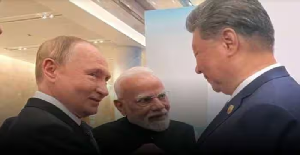

Hours after Prime Minister Narendra Modi was seen smiling and shaking hands with Chinese President Xi Jinping and Russian President Vladimir Putin at the Shanghai Cooperation Organisation (SCO) Summit in Tianjin, China, U.S. President Donald Trump lashed out at what he described as a “one-sided relationship” with New Delhi, blaming it for what he sees as unfair trade dynamics and for continuing to buy oil and weapons from Russia.
He posted a lengthy message on Truth Social late on Monday, claiming that most people “do not understand” the India-US trade relationship. “They do a tremendous amount of business with us… they sell us massive amounts of goods but we sell them very little. Until now, a totally one-sided relationship,” he wrote.
The post followed a day of significant diplomatic engagement at the SCO summit, where India, China and Russia met on common ground. The visuals of camaraderie between Modi, Xi and Putin stood in contrast to Washington’s growing frustration.
Continuing his familiar rhetoric, Trump called India a “tariff abuser”. He said that American businesses are unable to access the Indian market and repeated his complaint that New Delhi refuses to open up its agriculture and dairy sectors. “Our businesses are unable to sell to India,” he said.
His criticism also extended to India’s defense and energy ties with Moscow. “India buys most of its oil and military products from Russia… very little from the US. They have now offered to cut their tariffs to nothing… but it is getting late. They should have done so years ago. Just some simple facts for people to ponder!” the post ended, in his characteristic tone.
As Washington frowns, Beijing and Delhi seem to be building new bridges. Last month, Chinese Foreign Minister Wang Yi visited New Delhi for the first time in three years. Now, with Prime Minister Modi travelling to China for the first time in seven years, both sides appear keen on moving past old tensions.
Sources say India and China are exploring trade arrangements designed to ease the pressure of American tariffs. The two countries are among the world’s largest markets and opening trade channels between them could bring substantial economic gains.
Meanwhile, the impact of Trump’s tariff move is already being felt. A minimum of 50 percent duty has been imposed on a broad range of Indian imports into the United States. This includes a 25 percent penalty specifically targeting Indian purchases of Russian crude oil and arms. Indian goods worth nearly $48 billion are affected. Key sectors like textiles, gems and seafood exports are expected to bear the brunt.
The government has labelled the tariffs “unjustified, unreasonable and unfair”. Officials have defended the decision to continue buying discounted Russian crude by pointing to similar purchases by European nations. The government has made it clear that its priority remains protecting Indian farmers and ensuring energy security.
Efforts are now underway to reduce the blow. Officials say they are preparing support packages for impacted sectors and expanding export outreach. Talks are ongoing with 40 countries to diversify trade routes and reduce dependency on the U.S. market.
As global trade balances continue to shift, India appears to be recalibrating its alliances. And in Washington, frustration continues to grow.