
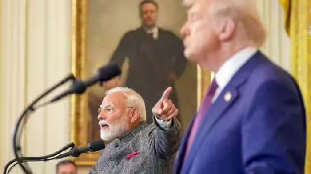

: The United States, led by U.S. President Donald Trump, has raised concerns over India’s ongoing defense and energy engagements with Russia. However, such criticism stands in sharp contradiction to America’s own past actions, where it repeatedly denied India access to critical defense technology. These actions left New Delhi with little choice but to explore alternatives, including strong military ties with Moscow.
In the late 1990s and early 2000s, India faced increasing threats on both its eastern and western borders. After the Kargil War, Pakistan, backed by China, accelerated its ballistic missile development programmes. Short and medium-range missiles began to pose a security challenge to India. In response, New Delhi urgently sought access to advanced air defense systems.
At that time, Israel had developed one of the most advanced air defense platforms in collaboration with the United States – the Arrow-2 Theater Missile Defense System. Designed to intercept short and medium-range ballistic missiles within a 300-kilometre radius, Arrow-2 was ideally suited for India’s needs.
New Delhi expressed its intent to purchase the Arrow-2 system from Israel, and Tel Aviv was ready to proceed with the deal. However, the United States exercised a veto power to block the transfer. Because the system was jointly developed, Israel needed U.S. approval to export it. Washington denied permission on the grounds that India was not a member of the Missile Technology Control Regime (MTCR), arguing that such a sale could destabilise regional security.
This reasoning came at a time when Pakistan, with Chinese assistance, was already manufacturing ballistic missiles, a move the United States chose to ignore. Ultimately, in 2002, Washington formally blocked the Arrow-2 sale, dealing a major setback to New Delhi’s air defense ambitions.
Around the same period, India also attempted to acquire the Falcon Airborne Warning and Control System (AWACS). Then Defense Minister George Fernandes visited Washington in 2002 to negotiate the deal. But once again, the United States turned India down. The rationale remained the same: such advanced technology in Indian hands might disrupt the regional balance of power. The decision was seen by many in New Delhi as favouring Pakistan’s strategic interests at the expense of New Delhi’s legitimate security concerns.
These repeated denials were not isolated incidents but part of a broader pattern. They pushed India to reassess its dependency on foreign defense suppliers. The rejection of the Arrow-2 system, in particular, became a turning point.
As a result, India ramped up indigenous research and development. The Defense Research and Development Organisation (DRDO) began working on the Ballistic Missile Defense (BMD) programme, which aimed to shield the country from land or aerial threats through a two-tiered interceptor system. The Phase-I of the programme led to the development of the Prithvi Air Defense (PAD) and Advanced Air Defense (AAD) interceptors. These systems could neutralise ballistic threats at both high and low altitudes, and were complemented by Swordfish long-range tracking radars and mission control centres to monitor incoming threats.
The success of these initial efforts laid the groundwork for the second phase of the BMD programme. Post-2016, the DRDO expanded its focus to develop interceptors capable of neutralising intermediate-range ballistic missiles (IRBMs) and hypersonic threats.
Air Defense-1, tested successfully in November 2022, demonstrated the ability to intercept missiles up to 5,000 kilometres in range. Air Defense-2, designed to protect against threats in the 3,000 to 5,500-kilometre range, followed. This multi-layered shield enabled India to protect strategic assets and urban centres using hit-to-kill technology.
Now, the programme is advancing into its most ambitious phase. During his Independence Day address, Prime Minister Narendra Modi announced the development of the Sudarshan Chakra Sky Shield, a comprehensive and AI-integrated air defense system to be deployed nationwide by 2035.
This Phase-III project aims to secure critical infrastructure, including metros, railways, hospitals and religious sites, through an indigenous network designed for full-spectrum protection.
Ironically, many of these developments began only after the United States denied India access to essential defense technologies. Washington’s repeated refusals forced New Delhi to innovate.
That same United States, which once cited regional peace as the reason for withholding arms from New Delhi, now takes issue with India’s procurement of Russian weapons systems and crude oil.
India’s pivot to Russia was never born out of preference but necessity. Moscow was willing to supply high-grade defense equipment without attaching political conditions. Russia became a consistent partner at a time when others hesitated. Today, when America criticises India for its defense cooperation with Russia, it overlooks the historical context that shaped those decisions.
The duality in Washington’s defense policy toward India, restricting access to critical technology in the past and now expressing discomfort over India’s strategic alternatives, continues to raise eyebrows in diplomatic and defense circles. For India, the lesson was clear: strategic autonomy cannot rest on the whims of foreign powers. The journey from denied imports to indigenous innovation stands as a testament to that realisation.