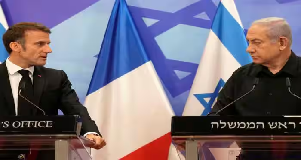

Tensions between France and Israel have escalated after President Emmanuel Macron rejected Prime Minister Benjamin Netanyahu’s accusations regarding rising antisemitism in France. Responding to the Israeli PM, the French president emphasised that the issue of antisemitism should not be “weaponised” for political gain.
In an open letter published on Tuesday, Macron stated, “These accusations of inaction in the face of a scourge that we are fighting with everything in our power are unacceptable and are an offence to France as a whole.”
He stressed the importance of unity in the fight against antisemitism, asserting that the issue should not be used to create discord between Israel and France. “The fight against antisemitism must not be weaponised and will not fuel any discord between Israel and France,” he said.
The conflict comes amid heightened political and social tensions, with Netanyahu accusing Macron of exacerbating antisemitism in France. The criticism stemmed from Macron’s announcement that France would recognise a Palestinian state during a United Nations meeting set for September.
Netanyahu referred to the recognition as “appeasement”, accusing Macron’s actions of fuelling antisemitism by supporting Hamas militants. “Your call for a Palestinian state pours fuel on this antisemitic fire. It is not diplomacy; it is appeasement,” he told the French president.
Macron also took the opportunity to address the ongoing conflict in Gaza, urging Netanyahu to bring an end to the violence. In his letter, he appealed directly to the Israeli leader, “I solemnly appeal to you to end the desperate race of a murderous and illegal permanent war in Gaza, causing indignity for your country and placing your people in a deadlock.”
Macron’s words reflect growing international concern about the humanitarian crisis in Gaza, which has been a point of contention for both countries.
Diplomatic Fallout, Rising Tensions
The war of words has led to a diplomatic row between France and Israel, with the French presidency hitting back strongly at Netanyahu’s accusations. The French office labelled Netanyahu’s remarks as “abject” and “erroneous” and vowed to respond with full force.
“This is a time for seriousness and responsibility, not for conflation and manipulation,” the statement read, adding that France has a strong commitment to the safety and protection of its Jewish citizens.
The French government reaffirmed its intolerance for any violence against Jews, reiterating its responsibility to safeguard their rights.
French Deputy Minister for European Affairs Benjamin Haddad also joined the defense, emphasising that France “has no lessons to learn in the fight against anti-Semitism”.
He argued that the growing antisemitism in European societies must not be used for political leverage or exploitation.
Meanwhile, Netanyahu’s accusations continue to create a ripple effect. His criticism has not only sparked outrage from France’s government but has also raised alarms within the European Union.
The tension reveals deeper cracks in the relationship between Israel and France as both nations struggle to balance their domestic concerns, particularly over antisemitism, while navigating the humanitarian impact of the Gaza conflict.
While Macron’s letter makes his position clear, the situation remains delicate. It remains to be seen how the two countries will handle the ongoing fallout. The growing diplomatic rift highlights the complex challenges world leaders face in addressing the broader Middle East conflict while maintaining their national interests.
Arab Parliament Condemns Israeli Escalation In West Bank
The Arab Parliament has condemned Israeli escalation in the West Bank, denouncing violent incursions and attacks by Israeli forces on Palestinian cities.
Speaker Mohamed bin Ahmed Al Yamahi stated that the violence in the West Bank, coupled with increased settler attacks, represented a continuation of Israel’s systematic oppression and displacement of Palestinians.
He emphasised the breach of international laws and humanitarian principles in the ongoing Israeli-Palestinian conflict.