
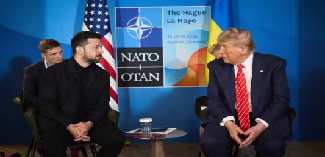

As Ukrainian President Volodymyr Zelensky prepared for a high-stakes meeting with US President Donald Trump at the White House on Monday, joined by a delegation of top European leaders, Trump increased diplomatic pressure, suggesting Ukraine must relinquish claims to certain Russian-occupied territories as part of any peace settlement.
Accompanied by a pointed warning, Trump posted on his Truth Social platform: “President Zelensky of Ukraine can end the war with Russia almost immediately, if he wants to, or he can continue to fight.”
Notably, Trump issued no equivalent ultimatum to Russian President Vladimir Putin, with whom he had held a summit just two days prior, on Friday.
In the same post, Trump laid out clear pre-conditions for ending the war, declaring: “No getting back Obama given Crimea (12 years ago, without a shot being fired!), and no going into NATO by Ukraine.”
Trump was referring to Russia’s annexation of Crimea in 2014 during Barack Obama’s presidency, implying that Ukraine would need to forgo reclaiming the peninsula in any peace deal. His comments also aligned with Russia’s demand that Ukraine abandon its ambitions of joining the NATO military alliance.
Some observers interpreted Trump’s statement as suggesting that, in exchange for recognition of Russia’s control over Crimea, Moscow might consider withdrawing from other Ukrainian regions it has occupied since its full-scale invasion began in February 2022. Russia currently controls around 20 per cent of Ukraine’s territory.
Steve Witkoff, Trump’s Special Envoy who attended the summit, told CNN: “The Russians made some concessions at the table with regard to all five of those regions” claimed by Moscow.
US Secretary of State Marco Rubio, also present at the Trump-Putin summit, hinted at the negotiation strategy during an interview with NBC: “The only way to reach a deal is for each side to get something and each side to give something.”
Zelensky is meeting Trump to follow up on the US-Russia summit in Alaska, which aimed to find a pathway to end the ongoing conflict.
Accompanying the Ukrainian president in Washington are key European leaders, including French President Emmanuel Macron, British Prime Minister Keir Starmer, German Chancellor Friedrich Merz, and European Commission President Ursula von der Leyen. The discussions are intended to pave the way for a trilateral summit involving Putin, aiming to narrow gaps and define negotiation terms.
However, both Zelensky and his European allies remain firmly opposed to any agreement that requires Ukraine to surrender territory.
After a strategic meeting with the European leaders, Zelensky wrote on X (formerly Twitter): “Everyone agrees that borders must not be changed by force.”
German Chancellor Merz echoed this sentiment, tweeting: “There are no territorial negotiations between Putin and Trump over the heads of Ukraine and the Europeans.”
Following his summit with Putin, Trump also dropped a previous demand for an immediate ceasefire, one that European leaders had agreed on, and backed away from threats of “severe consequences” for Russia if an agreement wasn’t reached.
European leaders are believed to be accompanying Zelensky to ensure he is not pressured into unfavourable concessions, particularly regarding Ukraine’s territorial integrity.
In February, during an Oval Office meeting, Trump had publicly scolded Zelensky over his demands, reportedly saying the Ukrainian president didn’t “have the cards” and was risking World War III by continuing the war.
However, Rubio rejected suggestions that Zelensky was being cornered by Trump, dismissing media speculation as false: “They’re not coming here tomorrow to keep Zelensky from being bullied,” he told CBS, adding: “The President invited them to come.”
Both Trump and Rubio have since acknowledged that the final decision on any peace agreement rests with President Zelensky.
Despite pressure, Zelensky noted a key diplomatic gain from the Trump-Putin summit: an agreement for robust security guarantees for Ukraine, with US participation.
“This is a historic decision that the United States is ready to take part in security guarantees for Ukraine,” Zelensky said, adding that these guarantees “must be developed with Europe’s participation” and include protections by land, sea, and air.
Witkoff also hailed the outcome, stating: “We agreed to robust security guarantees that I would describe as game-changing.” He added that Putin had agreed to pass legislation committing Russia not to invade Ukraine or other nations.