
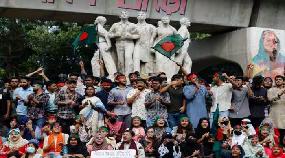

It has been a year since the dramatic ouster of Sheikh Hasina from power in Bangladesh. On August 5, the country marks the first anniversary of a student-led uprising that ended one of South Asia’s longest political reigns. Much has changed in these 12 months, but not in ways many Bangladeshis had imagined.
The country is still run by an unelected interim administration. Religious hardliners have gained ground. Reports of mob lynchings have gone up nearly twelvefold. The promise of democratic reform remains a hope, not a reality.
Once a tightly guarded fortress known as ‘Ganabhaban’, Hasina’s former official residence now is being turned into a public museum. The initiative is being led by the current caretaker government, headed by Nobel Peace Prize laureate Muhammad Yunus. The goal is to keep Bangladeshis reminding of what officials describe as “years of unchecked power and authoritarian rule”.
Before it became a symbol of political power, the estate had a different name, the Estate Rajbari. Once belonged to the maharajas (royal rulers) of Dighapatia, it was later taken over during the British and Pakistani administrations. Under Hasina, it served as the prime minister’s official residence for 15 years.
On August 5, 2024, crowds surged into the palace after Hasina fled by helicopter to India. Photos of protestors waving flags from the rooftop quickly went viral. The palace was no longer a seat of power, but a symbol of change.
The transformation of the place is underway. Curators are designing installations that feature testimonies from protestors, artworks by those who were killed and records of those who vanished in state custody.
One of the curators, Tanjim Wahab, says there will be interactive exhibits, animations and recreated holding cells. “We want young people to use this place as a space to discuss new ideas and imagine a democratic future,” news agency AFP had cited Wahab as saying.
The new museum is intended as a historical archive and also as a message to future generations. The vision is to preserve the rage, honor the fallen and never forget.
Human rights groups have documented systemic “abuses” under Hasina’s rule. Her government was accused of mass detentions, targeted killings and stifling dissent. The United Nations says over 1,400 people were killed during her final months in power.
Now 77, Hasina remains in India. Facing trials in absentia for alleged crimes against humanity, she maintains that she is innocent and says her life would be in danger if she returns to Bangladesh.
Yunus, now 85, says elections will be held in early 2026. Until then, his administration is focusing on institutional reform. But the road is rough. Religious factions and political infighting have slowed progress.
Ahead of the uprising’s anniversary, Human Rights Watch warned that the challenges are serious and growing.
The destruction did before and after her ouster did not stop at Ganabhaban. Protestors also demolished statues of Sheikh Mujibur Rahman, Hasina’s father and the country’s founding leader. Once turned into a museum by Hasina, his former home was torn down using bulldozers. Photos of his portrait being burned spread across social media.
One protestor, a 23-year-old student named Muhibullah al Mashnun, had said, “When dictatorship falls, its temples must fall too.”
Hasina’s critics say she turned democratic institutions into tools of control. Her supporters say the backlash has gone too far. But few dispute that her downfall has left a political vacuum.